
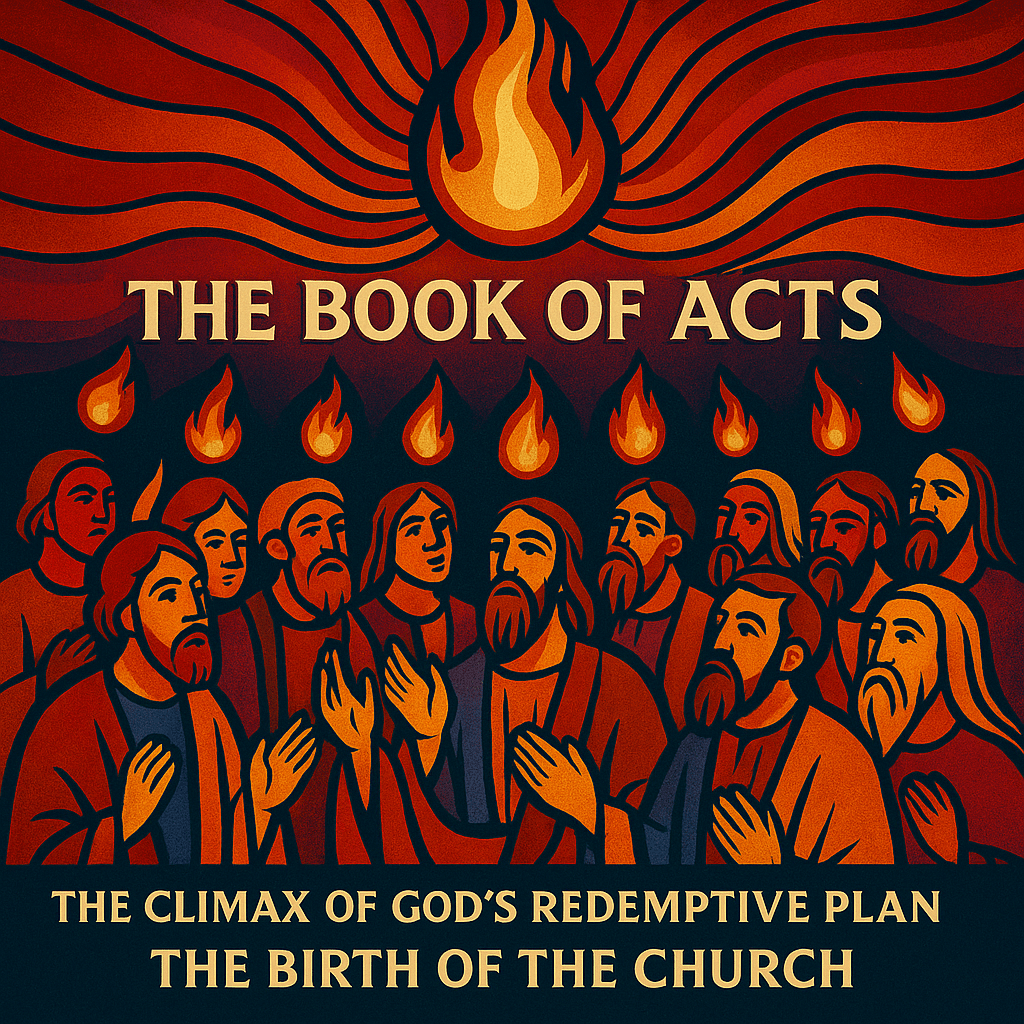
Led by Pastor Dan Kromidas Vox Church
My Personal Class Notes-
Theme: Spreading the News of the King – Mission of the Church
From Jerusalem to Rome — Then into all of the World
The Gospels
- Jesus enters into human history — earthly life, death, and resurrection
- His life reveals the kingdom of God through His life, words, and actions
- His death conquers sin; His resurrection ushers in a new era of salvation where He invites those who come after Him to join Him, walk by faith, and live as He lived
- Carrying on the mission
The Great Commission Texts
Matthew 28:18–20
- Matthew writes primarily to Jewish audiences
- Jesus is presented as KING
- Jesus is vindicated as the King; All AUTHORITY is recognized in Jesus
Mark 16:15–18
- Mark emphasizes Jesus coming with demonstrations of power
- He exalts Jesus’ greatness through signs
Luke 24:46–49
- Luke uses legal language from the justice system
- Believers are to witness and testify to others about Christ
John 20:21–22
- John records Jesus equipping us to go forth in peace
- Even though persecution and trouble will come, we are sent
The Book of Acts – The Climax of God’s Redemptive Plan
- Acts of the Apostles (and the Holy Spirit)
- Sequel to the Gospel of Luke
- Author: Luke
- Not an eyewitness, but deeply researched
- Spent time with Paul on his second missionary journey
- Only known Gentile author in the New Testament
- Joined Paul in modern-day Turkey
Supporting Scripture:
- Beloved Physician – Colossians 4:14
- Fellow Laborer – Philippians 1:24
Main Purpose of Acts
- Living out the kingdom of God
- Historical events and speeches
- Birth of the Church and a model for continuation
- A view of what life looks like when the Church lives in radical dependence on the Father through the Holy Spirit, modeled by Jesus
🔍 Important Question: How Should We Read the Book of Acts?
One of the biggest sources of denominational differences comes down to this:
Is the Book of Acts meant to be descriptive or prescriptive?
🟠 Descriptive
Some believe Acts is primarily a historical narrative, describing what happened—but not necessarily what must happen today.
Examples:
- Is baptism always immediate and public?
- Was the Apostolic Age a unique, unrepeatable season?
🔵 Prescriptive
Others see Acts as a model for the Church, prescribing how we’re called to live and minister.
Examples:
- Are signs and wonders still expected today?
- Is the charismatic movement a continuation of the early Church’s Spirit-filled mission?
Acts 1:6–8 – Setting the Stage
- The disciples ask Jesus about end times
- Christ ascends and is exalted – Acts 1:9
- Israel expected Jesus to ascend to Jerusalem’s throne, but He ascended to the throne of the universe
Supreme Authority
- Psalm 110
- Philippians 2:9–11
Prophetic Outpouring – Fulfilled at Pentecost
- Isaiah 42:1
- Ezekiel 37:14
- Joel 2:28–29
Jesus pours out His Spirit.
Pentecost Background
- Jewish Feast of Pentecost – Exodus 23:16, Deuteronomy 16:9–12
- Sign of the first fruits of the kingdom of God
- Signifies covenant renewal of Israel with God through Abraham
Acts 2:1–4 – Wind and Fire
- Wind – Power
- Fire – Presence
- God empowers believers to speak in tongues to reverse the Tower of Babel
- The gospel becomes accessible to all
Spirit Forms a Community
- Massive shift: The gospel becomes available outside Hebrew and Israel
- Peter explains in his sermon: “These are the last days…” – Acts 2:22–23
- The crowd responds: “What shall we do?” – v.38
- Answer: Repent and be baptized
Jesus is now working by His Spirit – He is the primary actor in the Book of Acts
Kingdom Principles in Action
- The Spirit’s first work: Empowering the community to share salvation – Acts 2:37–47
Three defining qualities of the early, healthy church:
- Devotion
- Signs and Wonders
- Numbers of Converts
Reverberating Witness – Acts 1:8 Visual
Diagram: Concentric Circles
• Jerusalem (center)
• Judea
• Samaria
• Ends of the Earth (outermost)
This illustrates how the gospel reverberates outward, starting from Jerusalem and expanding to the world.
Exodus 19:4 – The Church Witness in Jerusalem
Acts 3:1 – 6:7
- Witness starts in Jerusalem as ground zero
- Peter heals the lame man at the gate – Acts 3:12
- Peter and John: “We cannot help but speak what we’ve seen and heard.” – Acts 4:19–20
Response: Acts 4:23–31
- Increased prayer, boldness, and sharing
- Fresh filling of the Holy Spirit → More believers
- The religious leaders realize: The more they resist the gospel, the more it spreads
Great grace was upon them all – the Spirit of Jesus
Acts 5:12–16 – Hostility Grows
- The apostles begin to receive the same hostility Jesus experienced
- Despite opposition, people still come because of their needs
- The gospel spreads through compassion and power
John 14:12 – We Continue His Ministry
The Book of Acts cannot be only descriptive; it must be prescriptive for our churches today
We continue Jesus’ ministry, empowered by God through the Holy Spirit, to do great things in His name
Romans 8:10–11 – Resurrection Power in Us
- The disciples are arrested, but when they are released, they go right back to the temple to preach
- Acts 5:17
Jesus’ Prophetic Message
- Mark 13:9–11:
This is what you will experience. This is what you must do.
This is how the Spirit equips you.
Acts 5:41–42 – Rejoicing in Suffering
- They rejoice to be counted worthy to suffer
- Matthew 5:10–12
No political or human opposition can silence the gospel
Apostolic Witness Depends on Community
- Acts 6:1–2:
A community must verify the truth of the gospel through the lifestyle it lives
Acts 6:3–7 – Deacons Introduced
- Framework built for compassion and mercy
- New structures support the expanding church
Church Witnesses to Judea and Samaria – Acts 6:8 – 12:24
- Responsibility shifts beyond the apostles
- Stephen becomes the first martyr (not an apostle), stoned under Saul’s supervision in Acts 7
- Stephen dies echoing Jesus’ words
- Great persecution breaks out, scattering the church – Acts 8:4
Philip and Samaria – Acts 8:5–40
- Philip, like Stephen, was a deacon filled with the Spirit
- The gospel reaches Samaria with signs, wonders, conversions, and Holy Spirit outpouring
The Ethiopian Eunuch – Acts 8:26–40
- A crucial moment showing the power of the gospel to reach far beyond Jewish or apostolic circles
The gospel is now advancing further and further away, spreading beyond the apostles themselves
Judea and Samaria Witness – Acts 8–9
The gospel begins stretching beyond Jerusalem, just as Jesus promised in Acts 1:8—into Judea, Samaria, and beyond—not only through the apostles but increasingly through unexpected people and divine encounters.
The Ethiopian Eunuch: Gospel Reaches Further
• Philip’s encounter with the Ethiopian eunuch (Acts 8:26–40) reveals the Spirit-led, boundary-breaking nature of the gospel.
• This moment is hugely significant: the gospel travels through a court official of Queen Candace of Ethiopia—a Gentile from the ends of the earth, far beyond Jewish cultural borders.
• It affirms that God’s mission will not be limited to the Twelve or to one culture; it’s for all nations.
• This conversion story directly precedes Saul’s, juxtaposing inclusive grace with radical transformation.
The Conversion of Saul – Acts 9:1–30
Saul of Tarsus was not only a persecutor—he was profiting from the imprisonment of believers, rising in influence and satisfaction the more he crushed followers of “the Way.”
• He had followers of his own, gaining prestige with every Christian he bound.
• But on the road to Damascus, Jesus confronts him directly:
“Saul, Saul, why are you persecuting me?”
• This divine encounter blinds Saul physically, foreshadowing the spiritual blindness that is being healed.
Ananias: Reluctant Obedience, Radical Mercy
• God sends Saul to Ananias, a faithful disciple in Damascus.
• Ananias protests, knowing Saul’s violent reputation, but the Lord says:
“He is a chosen instrument of mine to carry my name before the Gentiles and kings and the children of Israel. For I will show him how much he must suffer for the sake of my name.” (Acts 9:15–16)
• Saul is healed; scales fall from his eyes—a miraculous sign of new vision and calling.
Saul Faces Opposition and Suspicion
• Saul immediately begins preaching that Jesus is the Son of God, but his past follows him.
• People are confused and afraid—his reputation as a violent persecutor precedes him.
• He faces threats, attempts on his life, and must escape Damascus by night.
• When he reaches Jerusalem, the disciples don’t trust him—until Barnabas stands up for him and vouches for his authentic transformation.
Overcoming the Image of Saul
This part of Saul’s journey is often overlooked, but it’s crucial:
• He had to overcome the shadow of his old self.
• His conversion wasn’t just a spiritual transformation—it required the Church to wrestle with mercy, discernment, and trust in the Spirit’s work.
• Opposition became part of his training—God was preparing Paul not just to preach the gospel, but to suffer for it.
1 Timothy 1:12–17 (ESV)
12 I thank him who has given me strength, Christ Jesus our Lord, because he judged me faithful, appointing me to his service,
13 though formerly I was a blasphemer, persecutor, and insolent opponent. But I received mercy because I had acted ignorantly in unbelief,
14 and the grace of our Lord overflowed for me with the faith and love that are in Christ Jesus.
15 The saying is trustworthy and deserving of full acceptance, that Christ Jesus came into the world to save sinners, of whom I am the foremost.
16 But I received mercy for this reason, that in me, as the foremost, Jesus Christ might display his perfect patience as an example to those who were to believe in him for eternal life.
17 To the King of the ages, immortal, invisible, the only God, be honor and glory forever and ever. Amen.
Philippians 3:4–11 (ESV)
4 though I myself have reason for confidence in the flesh also. If anyone else thinks he has reason for confidence in the flesh, I have more:
5 circumcised on the eighth day, of the people of Israel, of the tribe of Benjamin, a Hebrew of Hebrews; as to the law, a Pharisee;
6 as to zeal, a persecutor of the church; as to righteousness under the law, blameless.
7 But whatever gain I had, I counted as loss for the sake of Christ.
8 Indeed, I count everything as loss because of the surpassing worth of knowing Christ Jesus my Lord. For his sake I have suffered the loss of all things and count them as rubbish, in order that I may gain Christ
9 and be found in him, not having a righteousness of my own that comes from the law, but that which comes through faith in Christ, the righteousness from God that depends on faith—
10 that I may know him and the power of his resurrection, and may share his sufferings, becoming like him in his death,
11 that by any means possible I may attain the resurrection from the dead.
Acts 9 – Saul’s Journey: From Damascus to Jerusalem
After his conversion, Saul continues his ministry journey from Damascus to Jerusalem, marking a key shift in his identity and mission. Once feared as a persecutor, he now boldly proclaims Jesus as the Son of God.
• Churches began multiplying, especially through strategic preaching in Jewish synagogues, where Saul’s background as a Pharisee gave him unique access.
• His ministry thrives in regions with strong Jewish influence, allowing him to bridge understanding between the Law and the fulfillment found in Christ.
• Over time, Paul begins to gain the trust of the disciples, despite initial fear and suspicion. Barnabas plays a crucial role in affirming Paul’s testimony to the apostles in Jerusalem.
• This season reflects both the power of redemption and the early church’s cautious but Spirit-led discernment.
Acts 10–11:18
God reveals that the gospel is for all people, not just the Jews.
- Peter has a vision showing no one is unclean
- Cornelius, a Gentile centurion, receives the gospel
- Holy Spirit falls on Gentiles just as on Jews
- Peter defends the inclusion of Gentiles to the Jerusalem believers
Acts 11:19–12:24
Despite persecution, the church grows beyond Jerusalem and faces new threats.
- Scattered believers preach in Antioch; many Gentiles believe
- Barnabas brings Saul to help teach; disciples first called “Christians”
- Prophecy of famine leads to generous aid from Antioch
- James is killed by Herod; Peter is imprisoned and then miraculously freed
- Herod dies after exalting himself, and the word of God spreads
The Church’s Witness to Rome
The gospel begins to move intentionally toward the heart of the Roman Empire.
Acts 12:25–13:2
The Antioch church becomes a missionary hub through prayer and the Spirit’s leading.
- Barnabas and Saul return from Jerusalem with John Mark
- Church leadership prays and fasts
- Holy Spirit sets apart Barnabas and Saul for mission
Acts 13:2–14:28
Paul and Barnabas take the gospel to unreached regions, facing both fruit and fierce opposition.
- Missionary journey through Cyprus and Asia Minor
- Paul preaches in synagogues and to Gentiles
- Many believe, but persecution intensifies
- Churches planted and leaders appointed
- They return to Antioch and report all God has done
Acts 15
The church confirms that salvation is by grace, not the Law.
- Debate arises over circumcision for Gentile believers
- Jerusalem Council affirms salvation by grace through faith
- Letter sent to Gentile churches confirming this freedom
- Unity preserved despite cultural differences
Acts 15:36–16:40
Paul’s second journey begins, expanding the mission into Europe.
- Paul and Barnabas split; Paul chooses Silas
- Timothy joins the team
- Paul receives the Macedonian call
- Lydia is converted in Philippi
- Paul and Silas are jailed, worship in prison, and are miraculously freed
Acts 17–18:22
Paul boldly proclaims Christ in diverse cities, engaging both Scripture and culture.
- Preaches in Thessalonica, Berea, and Athens
- Faces resistance and hunger for truth
- At the Areopagus, Paul contextualizes the gospel for philosophers
- Plants a church in Corinth and is encouraged by a vision from God
Acts 18:23–20:4
Paul strengthens churches on his third journey and confronts spiritual conflict in Ephesus.
- Paul travels through Galatia and Phrygia
- Apollos is taught by Priscilla and Aquila
- Revival breaks out in Ephesus; idols are abandoned
- Paul faces intense opposition, but the gospel spreads
Acts 20:5–21:26
Paul prepares the churches for his departure and returns to Jerusalem despite warnings.
- Raises Eutychus from the dead after long teaching
- Farewell speech to Ephesian elders in Miletus
- Urges them to guard the flock and remain faithful
- Despite prophetic warnings, Paul presses on to Jerusalem
- Fulfills purification rites in the temple to avoid offending Jews
Acts 21:27–26:32
Paul is arrested and courageously testifies before rulers.
- Riot erupts in the temple; Paul is seized
- He gives his testimony to the crowd and is taken into Roman custody
- Appears before Felix, Festus, and King Agrippa
- Appeals to Caesar as a Roman citizen
Acts 27–28:31
Paul reaches Rome through shipwreck and suffering, proclaiming the kingdom boldly.
- Paul survives a storm and shipwreck on Malta
- Ministers through healing and miracles
- Arrives in Rome and is placed under house arrest
- Preaches the gospel boldly and without hindrance
Paul’s Trials and Encouragement
2 Corinthians 11:23-28
“Are they servants of Christ? (I am out of my mind to talk like this.) I am more. I have worked much harder, been in prison more frequently, been flogged more severely, and been exposed to death again and again. Five times I received from the Jews the forty lashes minus one. Three times I was beaten with rods, once I was pelted with stones, three times I was shipwrecked, I spent a night and a day in the open sea, I have been constantly on the move. I have been in danger from rivers, in danger from bandits, in danger from my fellow Jews, in danger from Gentiles; in danger in the city, in danger in the country, in danger at sea; and in danger from false believers. I have labored and toiled and have often gone without sleep; I have known hunger and thirst and have often gone without food; I have been cold and naked. Besides everything else, I face daily the pressure of my concern for all the churches.”
Philippians 4:11-13
“I am not saying this because I am in need, for I have learned to be content whatever the circumstances. I know what it is to be in need, and I know what it is to have plenty. I have learned the secret of being content in any and every situation, whether well fed or hungry, whether living in plenty or in want. I can do all this through him who gives me strength.”
Key Threads
• God’s kingdom & The Gospel spread ahead despite persecution, suffering, opposition, geographic, ethnic, cultural or social barriers
• Kingdom life of disciples filled with power. Message authenticated by signs & wonders
• A new era is inaugurated by outpouring of the Holy Spirit
• Primary teaching centers on person & works of Jesus. Response of faith and repentance required
• Prayer marks the early church movement


 VoxNotas
Leave a comment