
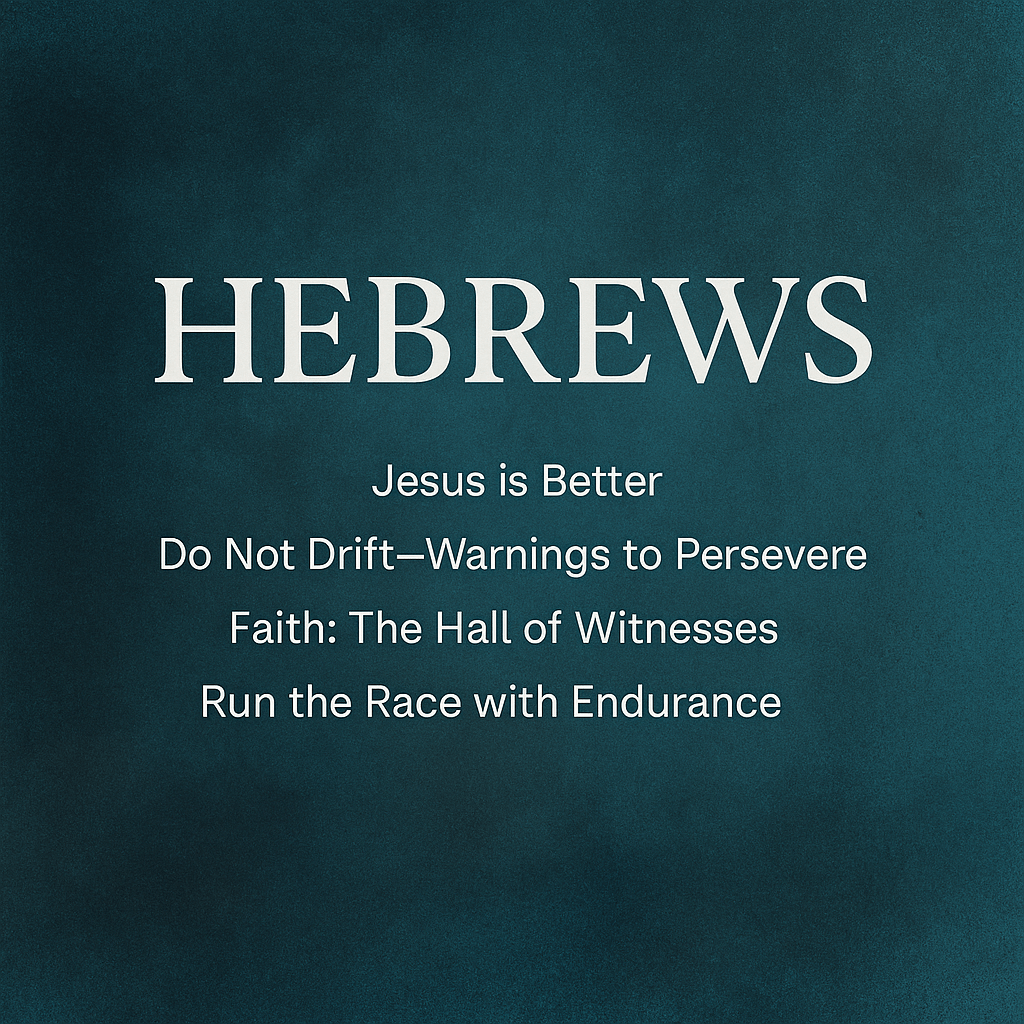
Session 8 – Hebrews
Led by Central Pastor Shawn Haggerty Vox Church
My Personal Class Notes-
Quote from Matthew Capps about Hebrews
“The book of Hebrews shows us how the Old Testament is not only a story that anticipates Christ, but how the work of Christ brings the Old Testament story to its climax and fulfillment.”
The book of Hebrews contains 35 direct quotations from the Old Testament. It is second only to the Book of Revelation in its use of Old Testament references. This heavy use of Scripture emphasizes the author’s deep connection to Jewish tradition and theology and points to an audience that would have been intimately familiar with the Old Testament scriptures.
Authorship: Unknown
The author of Hebrews is never named. Several candidates have been proposed throughout church history, including Barnabas, Apollos, and even Priscilla. However, most scholars agree that Paul was not the author. The Greek writing style is distinctly different from Paul’s known letters. Additionally, Hebrews 2:3-4 makes it clear that the author did not receive the gospel directly from Jesus Christ, but rather from those who heard Him:
Hebrews 2:3-4
“How shall we escape if we neglect so great a salvation? After it was at the first spoken through the Lord, it was confirmed to us by those who heard, God also testifying with them, both by signs and wonders and by various miracles and by gifts of the Holy Spirit according to His own will.”
This indicates a second-generation believer, someone who had received the gospel secondhand.
When Was Hebrews Written?
Scholars place the writing of Hebrews between 64 and 85 A.D. Several internal clues point to this time frame. The book references persecution, suffering, and hardship, likely referring to Roman oppression under emperors such as Nero (64 A.D.) or Domitian (85 A.D.).
Hebrews 10:32-34
“But remember the former days, when, after being enlightened, you endured a great conflict of sufferings, partly by being made a public spectacle through insults and distress, and partly by becoming companions with those who were so treated. For you showed sympathy to the prisoners and accepted the joyful seizure of your property, knowing that you have for yourselves a better and lasting possession.”
Hebrews 11:35-38
“Women received back their dead by resurrection; and others were tortured, not accepting their release, so that they might obtain a better resurrection; and others experienced mocking and flogging, and further, chains and imprisonment. They were stoned, they were sawn in two, they were tempted, they were put to death with the sword; they went about in sheepskins, in goatskins, being destitute, afflicted, tormented (people of whom the world was not worthy), wandering in deserts, on mountains, and sheltering in caves and holes in the ground.”
The ongoing function of the temple’s sacrificial system is assumed throughout the letter. This strongly suggests that the Temple in Jerusalem had not yet been destroyed by the Romans in 70 A.D., placing the date of writing most likely prior to that event.
To Whom Was Hebrews Written?
This letter was written to Jewish Christians, likely in a community familiar with intense Old Testament teaching and ceremonial law. The depth of Old Testament reference suggests the audience would have been practicing or formerly practicing Jews who had come to follow Jesus as Messiah. These were not new converts, but rather established believers. This is evident from several passages.
Hebrews 5:12
“For though by this time you ought to be teachers, you have need again for someone to teach you the elementary principles of the actual words of God, and you have come to need milk and not solid food.”
This passage shows that the audience had been believers long enough that they should be teaching others, yet they were still spiritually immature.
Major Themes in Hebrews
1. Jesus is Better.
Jesus is presented as superior to all previous ways God had made Himself known:
- Chapters 1–2: Jesus is better than angels.
- Chapters 3–4: Jesus is better than Moses and the promised land.
- Chapters 5–7: Jesus is better than the Levitical priesthood.
- Chapters 8–10: Jesus offers a better covenant and a better sacrifice.
This theme is introduced immediately in the opening verses.
Hebrews 1:1-4
“God, after He spoke long ago to the fathers in the prophets in many portions and in many ways, in these last days has spoken to us in His Son… He is the radiance of His glory and the exact representation of His nature…”
Angels were considered divine messengers and were even believed to have played a role in delivering the Law to Moses (Deuteronomy 33:2). But the writer of Hebrews insists that Jesus is far superior to angels.
Hebrews 1:14
“Are they not all ministering spirits, sent out to provide service for the sake of those who will inherit salvation?”
2. Do Not Drift—Warnings to Persevere
Hebrews is known for its five strong warning passages. These are not simply pastoral concerns; they are theological red flags about abandoning the faith.
Hebrews 2:1-3
“For this reason we must pay much closer attention to what we have heard, so that we do not drift away from it… how will we escape if we neglect so great a salvation?”
Hebrews 3:7-11 and 4:1
“Today if you hear His voice, do not harden your hearts as when they provoked Me… As I swore in My anger, ‘They certainly shall not enter My rest.’”
“Therefore, let’s fear, if, while a promise remains of entering His rest, any one of you may seem to have come short of it.”
Hebrews 6:4-6
“For it is impossible, in the case of those who have once been enlightened and have tasted of the heavenly gift… and then have fallen away, to restore them again to repentance…”
Hebrews 10:29
“How much more severe punishment do you think he will deserve who has trampled underfoot the Son of God…”
These warnings are heavy. They confront theological tensions—particularly whether salvation can be lost or not. This creates doctrinal conversations around perseverance, apostasy, and sanctification.
Doctrine and Truth Questions Raised in Hebrews
- Is Jesus both fully God and fully man, and why does that matter?
- What does it mean that Jesus is our Great High Priest?
- What is Jesus doing right now (Hebrews 7:25 – interceding)?
- Who are angels, and what do they do?
- Do we have assurance of salvation?
- What does it mean that salvation is both unconditional (God’s choice) and conditional (our response)?
Living the Truth – Practical Discipleship
- What role does the Holy Spirit play in my ability to persevere in the faith?
- How essential is the Church—my spiritual community—to my walk with God?
- What does it mean to “apply the blood of Jesus” to my sin and brokenness?
- What is true, biblical faith?
D.A. Carson Quote on Hebrews
“The epistle to the Hebrews is a sustained argument for the absolute supremacy of Jesus Christ, a masterful presentation of Christ as the ultimate revelation of God, superior to all others, and the fulfillment of all that came before.”
— D.A. Carson
Jesus’ Divinity Affirmed
Colossians 1:15-19
“He is the image of the invisible God, the firstborn of all creation… and He is before all things, and in Him all things hold together.”
Note: The Greek word prototokos (firstborn) refers not to order of birth but to status and rank of honor.
Philippians 2:6-11
“Although He existed in the form of God, did not regard equality with God a thing to be grasped… at the name of Jesus every knee will bow…”
Jesus as Greater than Moses and the Promised Land (Hebrews 3–4)
- Hebrews 3:3-6 – Jesus has more glory than Moses.
- Hebrews 4:9-11 – There remains a Sabbath rest, and Jesus is that rest.
- The generation in Numbers 11–14 failed to enter because of unbelief.
Jesus is Greater than the Priesthood (Hebrews 5–7)
Levitical priests were sinners and temporary. Jesus is our perfect and permanent priest.
Hebrews 6:19-20
“This hope we have as an anchor of the soul… Jesus has entered as a forerunner for us, having become a high priest forever according to the order of Melchizedek.”
Hebrews 7:23-25
“Jesus, on the other hand, because He continues forever, holds His priesthood permanently. Therefore He is able also to save forever those who come to God through Him, since He always lives to make intercession for them.”
Dane Ortlund on Intercession
“Intercession applies what the atonement accomplished. In the past Jesus did what He now talks about in intercession.”
— Dane Ortlund, Gentle and Lowly
D.L. Moody on the Sovereignty of God and Free Will
“When we walk through the gates of Heaven, we will see a sign that says, ‘Whosoever will may come.’ And when we pass through and look back, the other side of the sign will say, ‘Chosen before the foundation of the world.’”
Reformed Understanding of Sin and Salvation
- In the Reformed tradition, total depravity means every part of the human being, including the will, is affected by sin.
- People cannot even desire God unless He first regenerates their heart.
- Unconditional election and irresistible grace mean that salvation starts with God, not man.
- The warnings in Hebrews are seen as real but ultimately hypothetical in their outcome for the elect—they are the means God uses to keep His children faithful.
HEBREWS CHAPTERS 8–10
Jesus Mediates a Better Covenant
The argument in Hebrews moves to show how Jesus is not only a superior High Priest, but also the mediator of a new and better covenant, replacing the old Mosaic covenant which was always meant to be temporary and a shadow of what was to come.
Hebrews 8:6
“But now He has obtained a more excellent ministry, by as much as He is also the mediator of a better covenant, which has been enacted on better promises.”
This new covenant is grounded not in repeated sacrifices, but in the once-for-all sacrifice of Christ. The old system served its purpose but was never designed to bring full and final cleansing of sin.
Hebrews 8:13
“When He said, ‘A new covenant,’ He has made the first obsolete. But whatever is becoming obsolete and growing old is about to disappear.”
Chapter 9 contrasts the earthly tabernacle with the heavenly one, showing how Jesus, as our High Priest, entered the true Holy Place, not one made by human hands.
Hebrews 9:11–12
“But when Christ appeared as a high priest of the good things having come, He entered through the greater and more perfect tabernacle, not made by hands, that is, not of this creation; and not through the blood of goats and calves, but through His own blood, He entered the holy place once for all time, having obtained eternal redemption.”
Hebrews 9:14
“How much more will the blood of Christ, who through the eternal Spirit offered Himself without blemish to God, cleanse your conscience from dead works to serve the living God?”
Jesus’ sacrifice doesn’t merely cover sin like the old system—it cleanses the conscience and grants full access to God.
Chapter 10 continues this emphasis. The Law was a shadow—a temporary figure pointing forward.
Hebrews 10:1
“For the Law, since it has only a shadow of the good things to come and not the form of those things itself, can never, by the same sacrifices which they offer continually every year, make those who approach perfect.”
The old covenant could not take away sins permanently. But Christ’s one offering did what no priest or sacrifice before Him could ever accomplish.
Hebrews 10:10
“By this will, we have been sanctified through the offering of the body of Jesus Christ once for all time.”
Hebrews 10:14
“For by one offering He has perfected for all time those who are sanctified.”
This leads to a call to confidence and endurance:
Hebrews 10:19–23
“Therefore, brothers and sisters, since we have confidence to enter the holy place by the blood of Jesus, by a new and living way which He inaugurated for us through the veil, that is, through His flesh… let’s approach with a sincere heart in full assurance of faith… Let’s hold firmly to the confession of our hope without wavering, for He who promised is faithful.”
This section ends with another serious warning:
Hebrews 10:26–27
“For if we go on sinning willfully after receiving the knowledge of the truth, there no longer remains a sacrifice for sins, but a terrifying expectation of judgment…”
HEBREWS CHAPTER 11
Faith: The Hall of Witnesses
This chapter is one of the most well-known in all Scripture—a declaration of what it means to live by faith. The writer gives example after example of those who lived trusting God, even when they did not see the promises fulfilled in their lifetime.
Hebrews 11:1
“Now faith is the certainty of things hoped for, a proof of things not seen.”
Hebrews 11:6
“And without faith it is impossible to please Him, for the one who comes to God must believe that He exists, and that He proves to be One who rewards those who seek Him.”
He walks through the stories of Abel, Enoch, Noah, Abraham, Sarah, Isaac, Jacob, Joseph, Moses, Rahab, and many others. Each one obeyed, persevered, and lived by faith—even when the outcome was not clear.
Hebrews 11:13
“All these died in faith, without receiving the promises, but having seen and welcomed them from a distance…”
Hebrews 11:16
“But as it is, they desire a better country, that is, a heavenly one. Therefore, God is not ashamed to be called their God; for He has prepared a city for them.”
HEBREWS CHAPTER 12
Run the Race with Endurance
Chapter 12 opens with a charge to keep running the race of faith, inspired by the examples of those in chapter 11.
Hebrews 12:1–2
“Therefore, since we also have such a great cloud of witnesses surrounding us, let’s rid ourselves of every obstacle and the sin which so easily entangles us, and let’s run with endurance the race that is set before us, looking only at Jesus, the originator and perfecter of the faith…”
Jesus is the ultimate example—not just of faith, but of perseverance through suffering, having endured the cross for the joy set before Him.
This chapter encourages believers to see hardship and trials not as punishment, but as the loving discipline of a Father shaping His children.
Hebrews 12:6
“For the Lord disciplines the one He loves, and He punishes every son whom He accepts.”
There is also a final warning in this chapter: don’t refuse Him who is speaking. The kingdom of God is unshakable, and everything else will be removed.
Hebrews 12:28–29
“Therefore, since we receive a kingdom which cannot be shaken, let’s show gratitude, by which we may offer to God an acceptable service with reverence and awe; for our God is a consuming fire.”
HEBREWS CHAPTER 13
Living as the People of God
The final chapter shifts into practical exhortations for believers. These are the marks of a gospel-shaped community:
- Love one another as brothers and sisters.
- Show hospitality to strangers.
- Remember those in prison as though you were with them.
- Honor marriage.
- Keep your life free from the love of money.
- Respect and obey your spiritual leaders.
Hebrews 13:8
“Jesus Christ is the same yesterday and today, and forever.”
Even as everything around us changes, Jesus remains constant. He is the anchor, the High Priest, the better sacrifice, the better covenant, and the eternal intercessor.
Hebrews 13:15–16
“Through Him then, let’s continually offer up a sacrifice of praise to God, that is, the fruit of lips praising His name. And do not neglect doing good and sharing, for with such sacrifices God is pleased.”
The epistle closes with a benediction, rich in beauty and theological meaning:
Hebrews 13:20–21
“Now may the God of peace, who brought up from the dead the great Shepherd of the sheep through the blood of the eternal covenant, that is, Jesus our Lord, equip you in every good thing to do His will, working in us that which is pleasing in His sight, through Jesus Christ, to whom be the glory forever and ever. Amen.”
 VoxNotas
Leave a comment