
Led by Pastor Josh Vox Church
My Personal Class Notes-
In the earliest days of Christianity, the church was a Spirit-filled, people-driven movement marked by simplicity, unity, and bold witness. Leadership was initially apostolic and charismatic—centered around the authority of the Apostles and the work of the Holy Spirit in local communities. As the church grew and expanded across regions, it became necessary to establish patterns of leadership and structure to guard doctrine, maintain order, and shepherd the growing number of believers.
By the second and third centuries, church leadership evolved from informal gatherings into more formalized roles: bishops, elders (presbyters), and deacons. Over time, differing views on authority, oversight, and congregational participation led to distinct models of church governance that are still in use today.
In this post, we’ll explore those models in detail—Episcopal, Presbyterian, and Congregational—as well as how they function, where they came from, and why they matter. Below is the full breakdown:
Types of Church Government
Episcopal (bishop or overseer)
- A single leader at the top with regional and local leaders underneath.
- Authority is hierarchical—decisions flow from the top down.
- Bishops often have the final say in doctrine, ordination, and church discipline.
Examples:
- Roman Catholic
- Anglican
- Episcopal
- Greek Orthodox
Filled-in context for teaching or notes:
In an Episcopal system, the term “bishop” (Greek episkopos) refers to a senior overseer. This form of church government is structured like a pyramid: bishops oversee priests and deacons, and may convene in councils or synods. Authority is often institutional and sacramental, emphasizing apostolic succession and tradition.
This contrasts with:
- Presbyterian (governed by elders in representative councils)
- Congregational (local church autonomy, where members vote on major decisions)
Presbyterian (elder-led) (Vox Church)
- Authority rests with a body of elders (also called presbyters).
- In denominational churches: the local church is governed by a board of elders, which answers to a regional body of elders made up of representatives from multiple churches in a given region (called a presbytery or synod).
- In non-denominational churches: often a local elder board only, without broader oversight.
- Elders can be chosen by the congregation or through a committee within the board.
- If elders are chosen by the congregation, then the congregation typically has no authority to remove them unless specified in the church’s constitution.
Congregational (wide-range)
- Final authority rests with the congregation.
Varying degrees of congregational control:
- In some models, the congregation makes every decision (staffing, budget, doctrine, etc.).
- In others, the congregation elects primary leaders (pastors, elders) and entrusts them with decision-making.
- In most congregational settings, the congregation can remove a leader by vote.
- Most churches are independent, with no outside governing authority.
- However, they can have denominational affiliation (e.g., Baptist, Evangelical Free, etc.) while maintaining local autonomy.
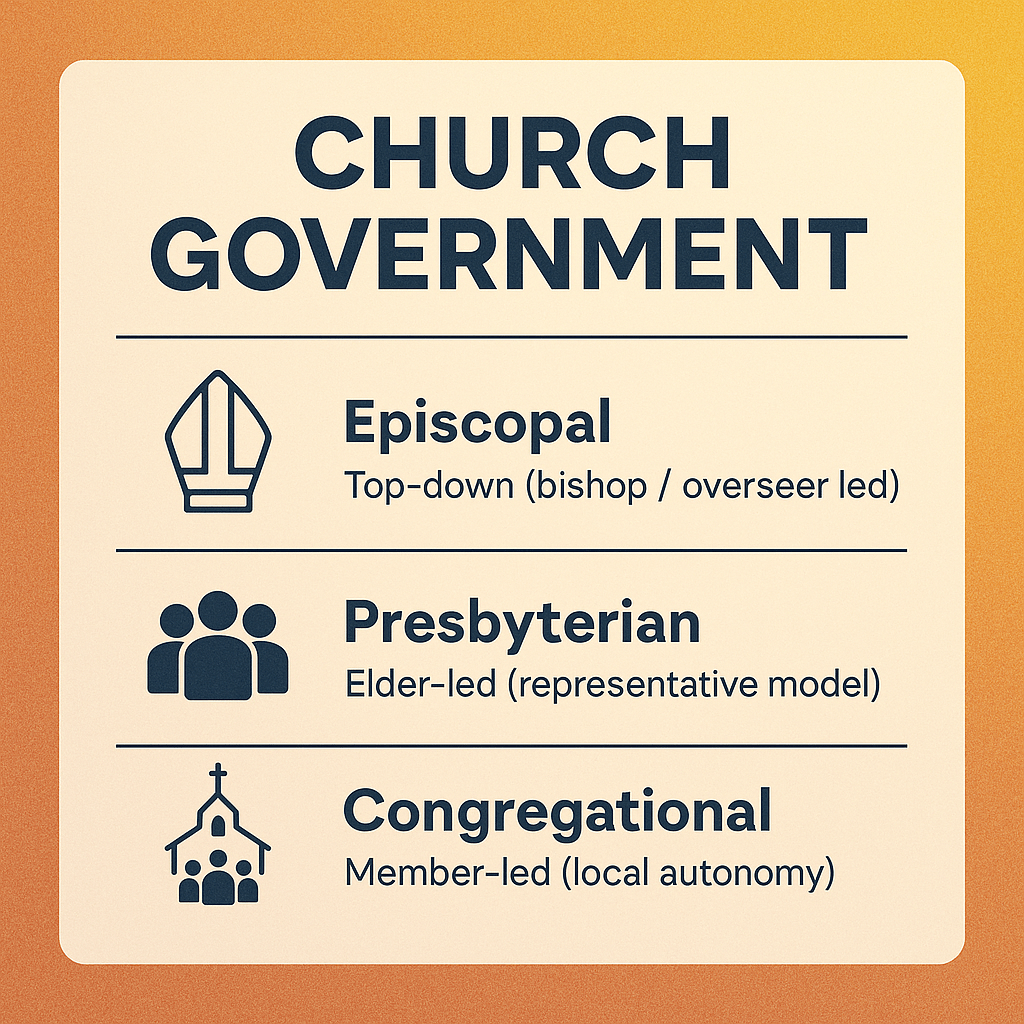
With this, you now have a full three-part comparative breakdown:
- Episcopal – Top-down (bishop/overseer led)
- Presbyterian – Elder-led (representative model)
- Congregational – Member-led (local autonomy)
 VoxNotas
Leave a comment