
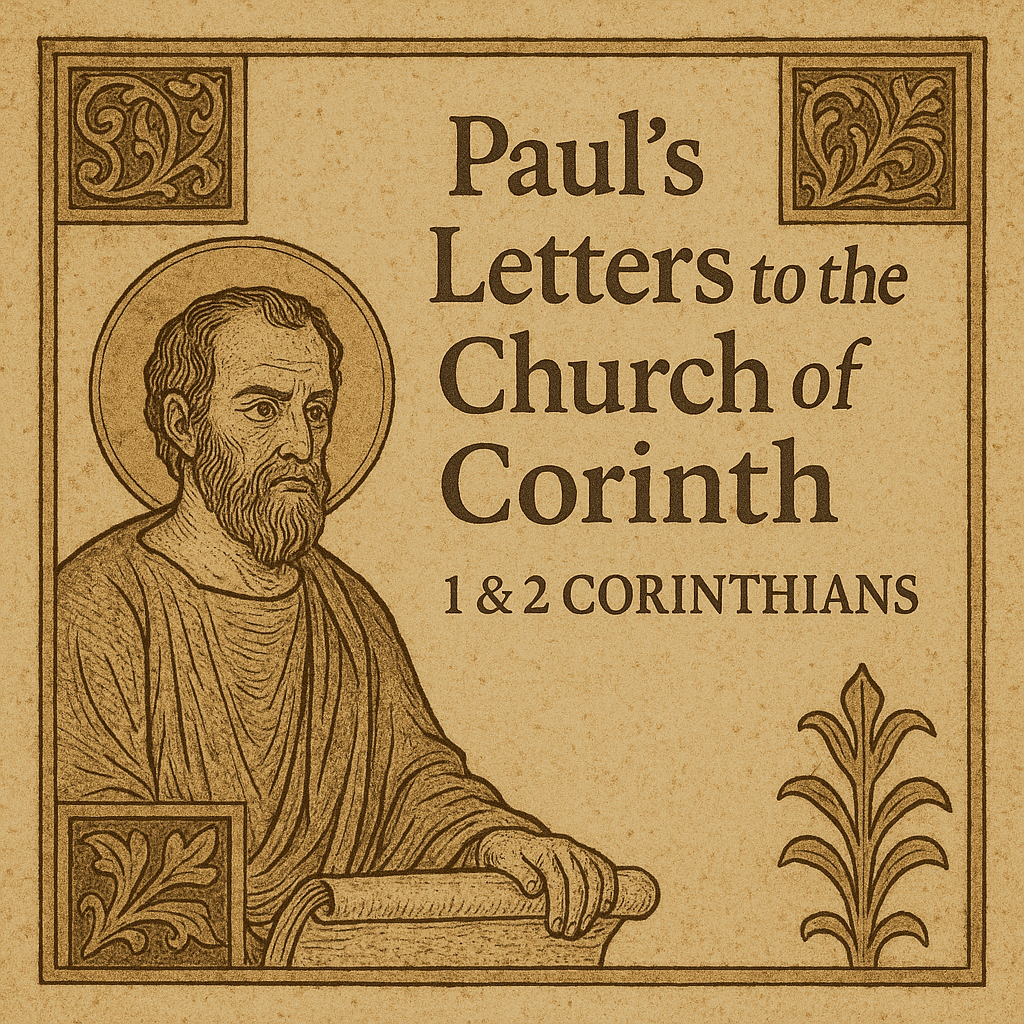
Led by Central Pastor Jake Rosekof Vox Church
My Personal Class Notes-
1 Corinthians
Background
- Author: Paul the Apostle
- Scribe: Sosthenes
- Date Written: ~A.D. 53–55
- Location Written From: Likely Ephesus, during Paul’s third missionary journey
- Audience: The church in Corinth (mostly Gentile believers with a few Jews)
Historical Context
Corinth was a wealthy, cosmopolitan city in southern Greece, known for:
• Commerce: Major trade route between Italy and Asia
• Culture: Intellectually proud and philosophically diverse
• Immorality: Infamous for its temple to Aphrodite, which promoted ritual prostitution—“to Corinthianize” meant to practice immorality
1 Corinthians is Paul’s bold and pastoral letter to a divided and morally compromised church in the bustling city of Corinth. Confronting issues like factionalism, sexual immorality, lawsuits among believers, and chaos in worship, Paul calls the church back to unity, holiness, and love. He addresses their questions on marriage, food offered to idols, spiritual gifts, and the resurrection, always grounding his answers in the gospel of Christ crucified and risen. At its heart, the letter challenges believers to live not by the wisdom of the world but by the wisdom of the cross—marked by humility, self-sacrifice, and love.
1 Corinthians – Chapter Breakdown by Topic
Ch. 1 – Divisions in the Church
Paul addresses factions forming around leaders (Paul, Apollos, Cephas, Christ) and calls for unity in the message of the cross.
🔹 1 Corinthians 1:10: “I appeal to you, brothers and sisters… that there be no divisions among you…”
Ch. 2 – Wisdom from the Spirit
Paul contrasts worldly wisdom with the Spirit’s wisdom, which reveals the mind of Christ.
🔹 1 Corinthians 2:10: “… these things God has revealed to us through the Spirit.”
Ch. 3 – Servants of God / Foundation in Christ
Paul explains that church leaders are merely servants and that Christ alone is the foundation.
🔹 1 Corinthians 3:11: “For no one can lay a foundation other than that which is laid, which is Jesus Christ.”
Ch. 4 – The Ministry of Apostles
Paul defends apostolic authority and models humility, urging the church to imitate him as a faithful servant.
🔹 1 Corinthians 4:1: “This is how one should regard us, as servants of Christ and stewards of the mysteries of God.”
Ch. 5 – Sexual Immorality and Church Discipline
A case of unrepentant sin is addressed; Paul commands the church to practice discipline for purity’s sake.
🔹 1 Corinthians 5:6: “Don’t you know that a little leaven leavens the whole lump?”
Ch. 6 – Lawsuits and Sexual Purity
Paul rebukes believers for suing each other and warns against sexual immorality, reminding them they are temples of the Holy Spirit.
🔹 1 Corinthians 6:9–11:
“Or do you not know that the unrighteous will not inherit the kingdom of God? Do not be deceived: neither the sexually immoral, nor idolaters, nor adulterers, nor men who practice homosexuality… will inherit the kingdom of God. And such were some of you. But you were washed…”
🔹 1 Corinthians 6:19–20:
“Do you not know that your body is a temple of the Holy Spirit within you…? You are not your own, for you were bought with a price. So glorify God in your body.”
Paul isn’t just condemning cultural behaviors; he’s drawing a moral boundary for Christians. These actions are framed as incompatible with the values of the Kingdom of God, which promotes holiness, love, self-control, and justice.
Ch. 7 – Marriage, Singleness, and Divorce
Paul answers questions about marital status, calling each believer to honor God in their situation.
Ch. 8 – Food Offered to Idols
Christian liberty is examined—Paul warns against using freedom in a way that causes others to stumble.
🔹 1 Corinthians 8:9: “But take care that this right of yours does not somehow become a stumbling block to the weak.”
Ch. 9 – Paul’s Rights as an Apostle
Paul lays down his rights for the sake of the gospel and models self-denial in ministry.
🔹 1 Corinthians 9:22–23: “I have become all things to all people… for the sake of the gospel.”
Ch. 10 – Warnings from Israel’s History
Paul warns against idolatry and presumption by drawing lessons from the Israelites’ failures.
🔹 1 Corinthians 10:12–13: “Let anyone who thinks that he stands take heed lest he fall…”
Ch. 11 – Head Coverings & The Lord’s Supper
Instructions on proper worship order and a rebuke for abusing the Lord’s Supper.
🔹 1 Corinthians 11:28: “Let a person examine himself, then, and so eat of the bread and drink of the cup.”
Ch. 12 – Spiritual Gifts and Unity
The body of Christ is made up of many members with diverse gifts—all vital and interdependent.
🔹 1 Corinthians 12:12–13: “Just as the body is one and has many members… so it is with Christ.”
Ch. 13 – The Way of Love
Love is the greatest virtue, superior to all gifts; without it, even the most spiritual acts are meaningless.
🔹 1 Corinthians 13:4–7: “Love is patient and kind… it bears all things, believes all things, hopes all things…”
Ch. 14 – Orderly Worship
Paul emphasizes edification and order in worship, especially regarding prophecy and tongues.
🔹 1 Corinthians 14:33: “For God is not a God of confusion but of peace.”
Ch. 15 – The Resurrection of Christ and Believers
A powerful defense of the bodily resurrection of Jesus and the future hope of believers.
🔹 1 Corinthians 15:12:
“Now if Christ is proclaimed as raised from the dead, how can some of you say that there is no resurrection of the dead?”
🔹 1 Corinthians 15:20–22:
“But in fact Christ has been raised from the dead… For as in Adam all die, so also in Christ shall all be made alive.”
Ch. 16 – Final Instructions and Greetings
Paul gives guidance on collections for the saints, travel plans, commendations, and final greetings.
🔹 1 Corinthians 16:13–14: “Be watchful, stand firm in the faith, act like men, be strong. Let all that you do be done in love.”
2 Corinthians
Purpose & Overview
2 Corinthians was written by Paul to defend his apostolic authority, reconcile with the Corinthian church after a painful visit, and encourage continued growth in faith and generosity. Personally attacked and questioned by false apostles, Paul responds with deep vulnerability and bold defense, showing that true ministry is marked by suffering, humility, and dependence on God. He affirms their repentance from his earlier “severe letter,” urges them to finish the collection for the poor in Jerusalem, and reveals his pastoral heart, spiritual depth, and unshakable commitment to the gospel.
1. Authorship & Date
- Written by: The Apostle Paul
- Scribe: Timothy (cf. 2 Cor. 1:1)
- Date: Around AD 55–56, likely from Macedonia
- Context: This comes after the events of 1 Corinthians and a painful visit to Corinth.
2 Corinthians 1:1 (ESV)
Paul, an apostle of Christ Jesus by the will of God, and Timothy our brother,
To the church of God that is at Corinth, with all the saints who are in the whole of Achaia.
Paul’s 5–7 Key Interactions with Corinth
- Founding Visit (Acts 18:1–18)
- AD 50–52. Paul plants the church, stays 18 months.
- Previous Letter (1 Cor. 5:9)
- Now lost. Warned them not to associate with the sexually immoral.
- 1 Corinthians
- Written from Ephesus (~AD 54–55). Addresses divisions, immorality, spiritual gifts.
- Painful Visit (2 Cor. 2:1)
- A short, difficult visit.
- Severe Letter (2 Cor. 2:4; 7:8–9)
- Now lost. Strong rebuke delivered by Titus. Led to repentance.
- 2 Corinthians (~AD 55–56)
- Written after good news from Titus. Paul defends his ministry, promotes generosity.
- Final Visit (Acts 20:2–3)
- A peaceful 3-month stay. Paul keeps his promise.
2 Corinthians – Chapter Breakdown & Key Teachings
Chapters 1–7: Paul’s Defense of His Ministry
- Comfort in Affliction 2 Cor. 1:4 – “He comforts us in all our affliction so that we may be able to comfort those who are in any affliction…”
God uses suffering to equip us for ministry to others. - Forgiveness and Restoration 2 Cor. 2:7 – “So now instead you should forgive and comfort him, so that he may not be overwhelmed by excessive sorrow.”
Paul encourages restoration and mercy. - Ministers of the New Covenant 2 Cor. 3:6 – “The letter kills, but the Spirit gives life.”
A contrast between law and Spirit—true ministry flows from the Spirit. - Treasure in Jars of Clay 2 Cor. 4:7 – “But we have this treasure in jars of clay to show that the surpassing power belongs to God and not to us.”
Human weakness reveals divine strength. - Ambassadors for Christ 2 Cor. 5:17 – “If anyone is in Christ, he is a new creation. The old has passed away; behold, the new has come.”
Reconciliation through Christ defines the believer’s identity and mission. - Commending Ourselves in Suffering 2 Cor. 6:4 – “As servants of God we commend ourselves in every way: by great endurance, in afflictions, hardships…”
Ministry is proven in faithfulness amid hardship. - Godly Sorrow and Repentance 2 Cor. 7:10 – “Godly grief produces a repentance that leads to salvation without regret, whereas worldly grief produces death.”
Their repentance brings Paul joy and affirms his trust in them.
Chapters 8–9: The Collection for the Saints
- The Generosity of the Macedonians 2 Cor. 8:3 – “For they gave according to their means, as I can testify, and beyond their means, of their own accord.”
An example of sacrificial giving for others. - Cheerful Giving 2 Cor. 9:7 – “Each one must give as he has decided in his heart, not reluctantly or under compulsion, for God loves a cheerful giver.”
The heart behind giving matters most.
Chapters 10–13: Paul Confronts His Opponents
- Paul’s Authority 2 Cor. 10:4 – “For the weapons of our warfare are not of the flesh but have divine power to destroy strongholds.”
Paul defends the spiritual nature of his authority. - False Apostles and Suffering 2 Cor. 11:14–15 – “Satan disguises himself as an angel of light. So it is no surprise if his servants… disguise themselves as servants of righteousness.”
Paul warns of deception in spiritual leadership. - Thorn in the Flesh 2 Cor. 12:9 – “But he said to me, ‘My grace is sufficient for you, for my power is made perfect in weakness.’”
Paul boasts in his weakness so that Christ’s power may rest on him. - Final Warnings and Greetings 2 Cor. 13:5 – “Examine yourselves, to see whether you are in the faith. Test yourselves.”
Paul ends with a call to integrity, repentance, and peace.
Themes to Reflect On
Ministry often involves pain, but it also brings deep joy.
True strength is revealed in human weakness.
Godly leadership is marked by humility, sacrifice, and truth.
Repentance restores unity in the church.
Generosity is both spiritual and practical.
 VoxNotas
Leave a comment