
Led by Central Pastor Sean Haggerty Vox Church
My Personal Class Notes-
🔹 Blog Index
- The Bible as a Unified Story
- Themes of covenant, redemption, and restoration
- How the New Testament fulfills the Old
- Context for the New Testament
- Intertestamental silence and anticipation
- The cultural world Jesus was born into
- Jesus as the Climax
- How Jesus completes Israel’s story
- His role as Messiah and Kingdom-bringer
- Scripture as Invitation
- How we enter the story today
- Responding with faith, surrender, and participation
Class Introduction
For a more detailed study of the Intertestamental period please see the notes from the Old Testament Overview – Intertestamental Period – A Kingdom Story Waiting for an Ending– Part 8
Historical Context
- The Temple had been destroyed, and Israel’s identity was in flux during the Intertestamental period.
- Synagogues emerged to fill the void left by the Temple’s destruction.
Synagogue Structure and Practice
- The Bema (platform) was placed in the middle of the synagogue.
- Elders would ascend the platform to read from the Scriptures.
- Jesus announces His messianic identity on such a platform.
- Luke 4:16–21 – Jesus reads from Isaiah and declares the prophecy fulfilled in their hearing.
- The central placement of the Bema symbolized that the Torah—the Word of God—was life.
- People gathered around the Word, emphasizing community and reverence.
- As the Hellenistic worldview gained influence, the platform moved forward and became a stage.
- The Word was no longer communal but became performance-based.
- This class will replicate the original model:
- Reading a text
- Gathering in community
- Listening to God together
Foundational Text
- Hebrews 12:1–2 – Fix our eyes on Jesus, the author and finisher of our faith.
The Great Confrontation – Universal Questions
- Who is God?
- Who am I?
Identity and Calling
- John 1:21–33 – “Who are you?”
- John the Baptist deflects identity questions to point to Jesus.
- His identity was rooted in who Jesus is, not in what he did.
- John 3:30 – “He must increase, but I must decrease.”
- The Bible is not primarily interested in what you do, but in who you are in relation to who God is.
Christian Faith – A Worldview
Everyone Has a Worldview
Formed by these questions:
- Who am I?
- Why am I here? (Purpose and belonging)
- What’s wrong with the world?
- What’s the solution?
The Christian Worldview
- Confrontational in a pluralistic, self-focused culture.
- Daniel and the Furnace (Daniel 3) – What do we do while we wait for God’s promises?
Biblical Worldview
- Not about self-discovery, but looking to Scripture.
- God reveals the answers as the source and foundation of all knowledge.
Truth in the Bible
- Propositional Truth: Scripture as the Word
- To propose is to offer a truth—not a question, but a truth that can be accepted or rejected.
- John 14:6 – “I am the way, the truth, and the life.”
- John 1:1, 14 – The Word became flesh and dwelt among us.
- Acts 4:12 – Salvation is found in no one else but Jesus.
- Truth is embodied in the person of Jesus Christ.
- The Bible proposes revealed absolute truths for interpreting the world.
John Stott: “The Word became flesh.”
John Stott emphasized that the incarnation and the cross show us that God does not stand apart from human suffering—He entered into it. The cross is the ultimate picture of divine suffering and love.
We still wrestle with human suffering, but the cross is the picture of divine suffering.
The Redemption Plot
Creation – Fall – Promise – Redemption – Kingdom – Restoration
Act 4: The Coming of the King – Redemption Accomplished
- The New Testament is the climax of the redemption story.
- The primary message of Jesus: the Kingdom of God.
Covenants and Promises
- Covenants establish the relationship between God and man.
- Always based on who God is, not who we are.
- Marriage helps illustrate this but falls short due to human failure.
Israel’s Unfaithfulness
- Hosea 2:19–20 – God promises betrothal forever in righteousness, love, and faithfulness.
- Jeremiah 31:31–32 – A new covenant not like the old, broken one.
Who is God in the Covenants?
- God makes, keeps, and fulfills His covenants.
- Genesis 17:7 – Everlasting covenant with Abraham’s descendants.
- Jeremiah 7:32 – The consequences of forsaking the covenant.
📜 Covenant List
| Covenant | Scripture | Covenant Partner(s) | Promise | Sign |
|---|---|---|---|---|
| Adamic | Genesis 1–3 | Adam (Humanity) | Dominion over creation, be fruitful and multiply, redemption promised after the Fall | The Sabbath, the Seed (Genesis 3:15) |
| Noahic | Genesis 6:18; 8:20–9:17 | Noah and all living creatures | Never again to destroy the earth by flood | Rainbow |
| Abrahamic | Genesis 12:1–3; 15:1–21; 17:1–14 | Abraham and his descendants | Land, offspring, blessing to all nations | Circumcision |
| Mosaic (Sinai) | Exodus 19–24; Deuteronomy 5 | Israel (as a nation) | Blessing for obedience, curse for disobedience; priestly kingdom | The Law / Tablets of Stone |
| Priestly | Numbers 25:10–13 | Phinehas (and priesthood) | Perpetual priesthood through faithful zeal | Peace and priestly line |
| Davidic | 2 Samuel 7:8–16 | David and his lineage | Eternal kingdom through David’s heir | The Throne |
| New Covenant | Jeremiah 31:31–34; Ezekiel 36:26–27; Luke 22:20; Hebrews 8 | All believers through Christ | Forgiveness of sin, transformed hearts, indwelling Spirit | The Blood of Jesus (Communion) |
Seed and Promise
- Covenants in Scripture are passed down by SEED and presented through PROMISE.
- Romans 5:19–21 – Where sin increased, grace increased all the more.
The law was brought in so that trespasses might increase. Why?
So that grace would abound, leading us to eternal life through Jesus Christ.
It’s like turning on a spotlight in a dark room—the filth is exposed, not to shame, but so it can finally be cleansed. Grace doesn’t ignore sin—it triumphs over it. So, the law increases the awareness of sin so that grace can be fully understood, fully received, and fully glorified in Christ.
The Redemption Plot – The Great Why
- 2 Corinthians 1:1–8 – God’s comfort in affliction. Purpose in suffering.
- Galatians 3:22–24 – The law as a guardian leading us to Christ.
End of the Old Testament
- Ends with Israel in exile, having forfeited the land and relationship with God.
- 400 years of silence, 600 years of oppression.
Summary: The Oppression Timeline
| Empire | Years | Key Rulers/Events | Impact on Israel |
|---|---|---|---|
| Babylon | 605–539 BC | Nebuchadnezzar | Temple destroyed, exile begins |
| Persia | 539–331 BC | Cyrus the Great, Darius | Return and rebuild Temple |
| Greece | 331–167 BC | Alexander the Great, Antiochus IV | Hellenization, severe persecution |
| Maccabees | 167–63 BC | Judas Maccabeus, Hasmoneans | Independence with internal decline |
| Rome | 63–4 BC+ | Pompey, Caesar Augustus, Herod the Great | Harsh control, religious unrest |
Hope for Israel
- Psalm 136 – His steadfast love endures forever.
- Micah 7:20 – God shows faithfulness and steadfast love.
- Jeremiah 33:22 – God’s promise of innumerable descendants.
- Jeremiah 31:20 – Ephraim is a dear son; God’s compassion is stirred.
Matthew Patton: “Israel stirs in the heart of God deep wells of compassion.”
The New Testament
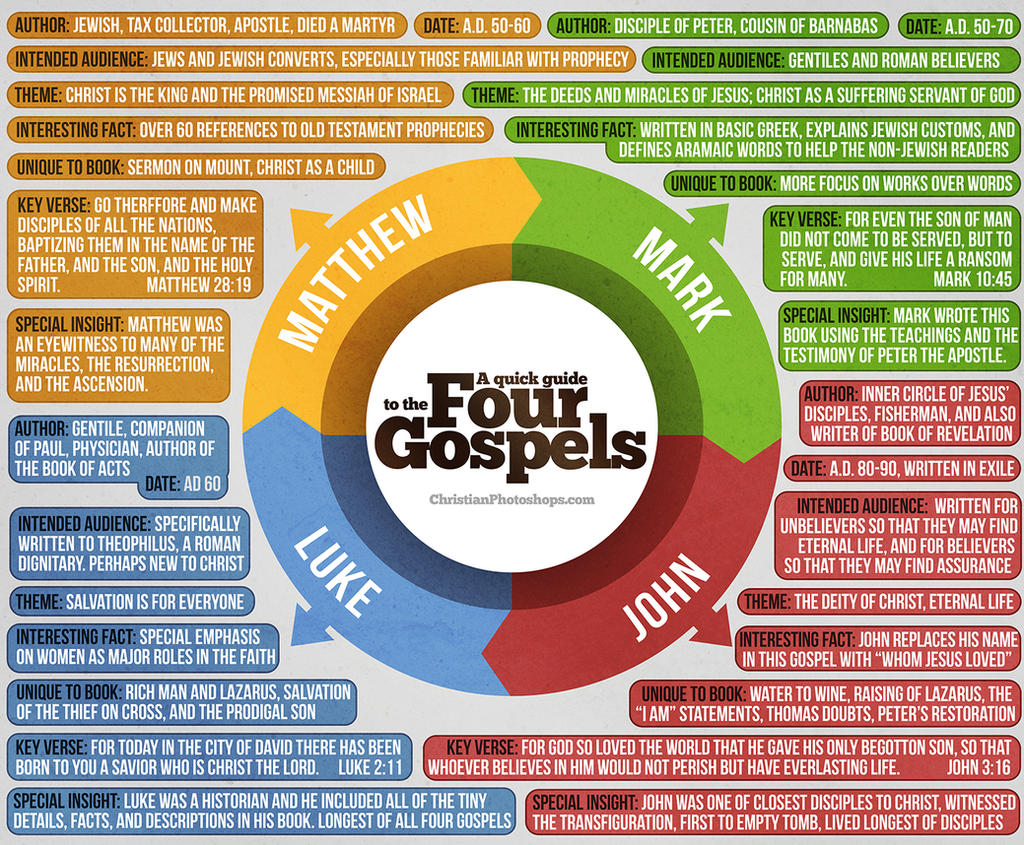
Gospel Breakdown
| Gospel | Author | Date Written | Audience | Emphasis / Theme | Key Image of Jesus |
|---|---|---|---|---|---|
| Matthew | Matthew (Levi), a Jewish tax collector & disciple | ~AD 60–70 | Primarily Jews | Jesus as the Messiah, Fulfillment of OT Prophecy | King of the Jews (Messianic King) |
| Mark | John Mark, companion of Peter | ~AD 50–60 (earliest) | Roman/Gentile Christians | Jesus as the Suffering Servant, Man of action | Servant-King (Power through sacrifice) |
| Luke | Luke, a physician and companion of Paul | ~AD 60–70 | Greek/Gentile believers | Orderly account, historical detail, Jesus’ humanity and compassion | Son of Man (Universal Savior) |
| John | John, “the beloved disciple” | ~AD 80–90 | Universal/Church at large | Jesus as divine Son of God, eternal Word made flesh | Son of God (Divine Revealer) |
Overarching Message
- Central message: The Kingdom of God
- Jesus preaches, demonstrates, and embodies the Kingdom.
👑 The Kingdom of God
Jesus’ Identity and Power
- The Kingdom of God is not a place—it’s God’s reign breaking into human history through Jesus Christ.
- It’s wherever God’s rule and will are done, on earth as it is in heaven (Matthew 6:10).
- Jesus doesn’t just preach the Kingdom—He embodies it.
- His identity is the foundation of the Kingdom.
- His authority is what advances it.
- Jesus is not just the messenger of the Kingdom—He is the King.
- Luke 4:16–21 – Jesus reads Isaiah in the synagogue:
“The Spirit of the Lord is upon me…”- He declares the Kingdom is now here with Himself as its fulfillment.
- Luke 4:16–21 – Jesus reads Isaiah in the synagogue:
⚡ Power Shift – How the Kingdom Advances
🔥 1. Prayer
- Jesus models intimacy with the Father through constant prayer.
- His prayers reflect dependence, not just religious duty.
- Mark 1:35 – Jesus withdraws early to pray.
- Luke 11:1 – Disciples ask, “Lord, teach us to pray…”
- Prayer is how heaven’s authority breaks into earthly situations.
🕊️ 2. The Holy Spirit
- The Spirit empowers Jesus’ ministry and is poured out to empower believers.
- Luke 4:1–2 – Jesus, “full of the Holy Spirit,” is led into the wilderness to confront the enemy.
- Luke 4:14 – He returns in the power of the Spirit to begin preaching and healing.
- Acts 1:8 – Believers are told they will receive power when the Spirit comes to be witnesses of the Kingdom.
👑 3. Sonship in Christ
- Jesus’ identity as the Son of God is central to Kingdom authority.
- Matthew 3:17 – “This is my beloved Son…”
- Identity came before action—He was affirmed before He performed.
- Kingdom authority flows from knowing who you are in relation to the Father.
- Through Jesus, we become sons and daughters, sharing in His authority:
- Romans 8:14–17 – We are heirs with Christ.
- Galatians 4:6–7 – No longer slaves, but sons.
🌍 The Kingdom Today
- The Kingdom is already here in part but not yet fully realized.
- It advances not through force but through Spirit-empowered lives.
- We don’t just proclaim the Kingdom—we live it, reflect it, and call others into it.
 VoxNotas
Leave a comment