
Lead by Norwalk Campus Pastor Dan Kromidas Vox Church
My Notes-
Old Testament – A Kingdom Story Waiting for an Ending
Israel’s Unfolding Story
- The people of Israel are living back on the land in relative peace.
- The Temple is rebuilt, sacrifices and the priestly system are resumed.
- Jerusalem’s walls are reconstructed (Nehemiah).
- The covenant is renewed under the leadership of Ezra.
- There is a fresh zeal for the Torah in the life of Israel.
- Yet, they are still under the domination of a foreign power and ruler — Persia.
God’s Promise
Garden Scene: Divine Conqueror.
Abraham: A great nation, a renowned name, a blessing to all people, judgment upon enemies, and a promised land.
Moses: A kingdom of priests and a holy nation, peace.
David: A dynasty of kings, rest from enemies, a permanent temple, and an ultimate king.
Promises Seem Unfulfilled Even After Coming Out of Exile
- Exile fundamentally didn’t change anything — Israel’s heart is still hard.
Final Words of the Old Testament
Zechariah Themes
- Rejected Shepherd King sent to deliver his people.
- A future “Day of the Lord” — God’s justice will confront evil; God will pour out a spirit of repentance; a remnant will be preserved.
- A new city, a new garden, and a new healing river full of living water.
Malachi 3:1
“I will send my messenger, who will prepare the way before me. Then suddenly the Lord you are seeking will come to his temple; the messenger of the covenant, whom you desire, will come,” says the Lord Almighty.”
Malachi 4:4-6
“Remember the law of my servant Moses, the decrees and laws I gave him at Horeb for all Israel.
See, I will send the prophet Elijah to you before that great and dreadful day of the Lord comes.
He will turn the hearts of the parents to their children, and the hearts of the children to their parents; or else I will come and strike the land with total destruction.”
Sum of the Sins of Israel
- Idolatry – Influenced by other cultures to worship other gods.
- Immorality – Lack of reverence for holiness.
- Injustice – People are oppressed, the poor are taken advantage of, and those in power abuse their authority.
Joel 2
“And afterward, I will pour out my Spirit on all people. Your sons and daughters will prophesy, your old men will dream dreams, your young men will see visions.
Even on my servants, both men and women, I will pour out my Spirit in those days.
I will show wonders in the heavens and on the earth, blood and fire and billows of smoke.
The sun will be turned to darkness and the moon to blood before the coming of the great and dreadful day of the Lord.
And everyone who calls on the name of the Lord will be saved; for on Mount Zion and in Jerusalem there will be deliverance, as the Lord has said, even among the survivors whom the Lord calls.” (Joel 2:28-32)
What to Include in the Bible
- Authorship – Are they known? (Source Criticism)
- Message – Congruency of the message – Doctrinal alignment.
- Test of Time – Were the writings accepted and affirmed throughout history as time moved forward?
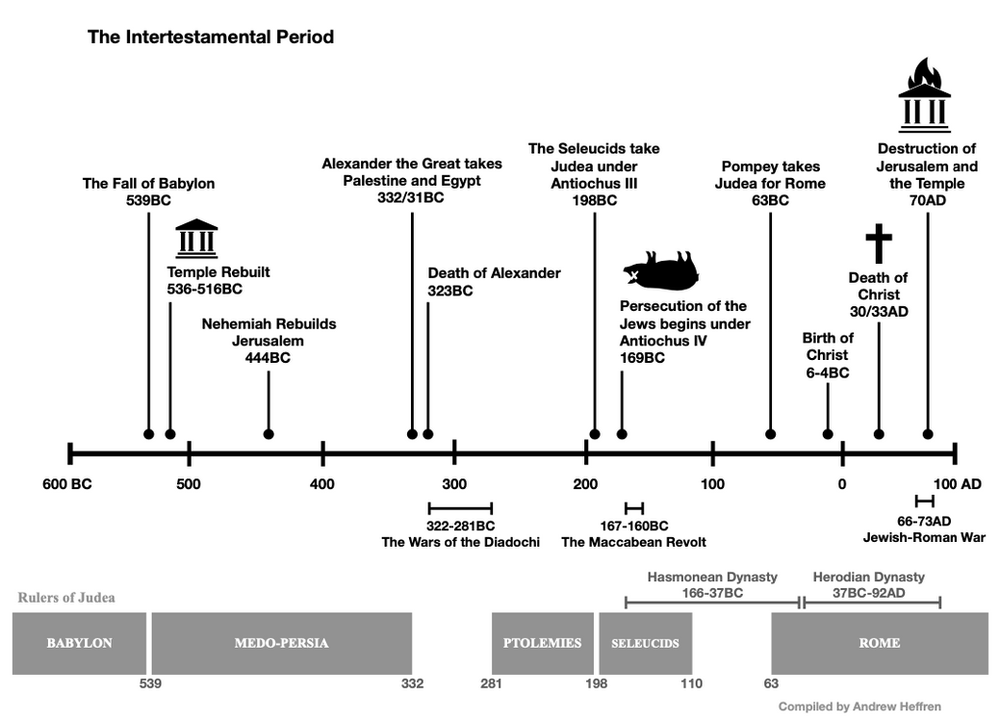
Intertestamental Period – 400+ Years of Silence
Differences Between the End of the Old Testament and the Beginning of the New Testament:
- Change in dominant foreign regime.
- The majority of Jews were scattered.
- Challenges in maintaining covenant identity.
- Difficulty in keeping Torah and religious observances.
- Pressure to compromise with pagan cultures.
- God longs to act and liberate His people.
Fences
Religious leaders created “fences” for the common people to ensure they remained faithful to the law. However, they lost the understanding of the heart and the spirit of the law. These religious leaders and their fences were often the targets of Jesus’ scorn.
Five Core Beliefs for Israel
- Monotheism – Belief in one true God.
- Election – God chose Israel for a special purpose.
- Torah – God gave the law to direct Israel’s life.
- Land – God promised a land where He would dwell with them.
- Future Hope – A hope for a future redemptive act of God.
Empires
- Babylon (605–539 BC)
- Conquered Jerusalem in 605 BC under Nebuchadnezzar.
- Destroyed the Temple in 586 BC.
- Exiled the Jewish people to Babylon.
- Persia (539–331 BC)
- Conquered Babylon in 539 BC under Cyrus the Great.
- Issued the decree allowing Jews to return and rebuild the Temple (Ezra 1:1-4).
- Temple rebuilt in 515 BC.
- Greece (331–63 BC)
- Alexander the Great defeated the Persians in 331 BC.
- After Alexander’s death, his empire was divided among his generals (Ptolemies and Seleucids).
- Antiochus Epiphanes desecrated the temple in 167 BC (Abomination of Desolation).
- Rome (63 BC–476 AD)
- Pompey conquered Jerusalem in 63 BC.
- Ruled through local puppet kings, including Herod the Great (37–4 BC).
- Direct Roman rule began under Pontius Pilate in AD 26.
Life Within the Persian Empire
- Decree of Cyrus – 539 BC. The Decree of Cyrus (539 BC) was an official proclamation issued by Cyrus the Great, the king of Persia, following his conquest of Babylon. It allowed the Jewish exiles, who had been taken to Babylon after the destruction of Jerusalem and its temple, to return to their homeland. The decree not only permitted the rebuilding of the temple in Jerusalem but also provided resources, including returning sacred items that had been looted from the temple by the Babylonians. This act fulfilled the prophecy found in the Book of Jeremiah and marked the beginning of the end of the Jewish exile. It also demonstrated Cyrus’s belief that the God of Israel had granted him authority over the kingdoms of the earth and that it was his duty to restore Israel’s worship practices. Despite the decree, many Jews chose to remain in Persia, while others returned to Jerusalem to rebuild.
- Not all Israelites returned to the land.
- The rebuilt temple was underwhelming compared to Solomon’s temple.
- Israel remained subject to a foreign pagan master.
- Shattered dreams led to renewed focus on Torah (Deuteronomy 30).
Deuteronomy 30:5-9 (NIV)
“He will bring you to the land that belonged to your ancestors, and you will take possession of it. He will make you more prosperous and numerous than your ancestors. The Lord your God will circumcise your hearts and the hearts of your descendants, so that you may love him with all your heart and with all your soul, and live. The Lord your God will put all these curses on your enemies who hate and persecute you. You will again obey the Lord and follow all his commands I am giving you today. Then the Lord your God will make you most prosperous in all the work of your hands and in the fruit of your womb, the young of your livestock, and the crops of your land. The Lord will again delight in you and make you prosperous, just as he delighted in your ancestors.”
Deuteronomy 30:11 (NIV)
“Now what I am commanding you today is not too difficult for you or beyond your reach.”
Deuteronomy 30:16-18 (NIV)
“For I command you today to love the Lord your God, to walk in obedience to him, and to keep his commands, decrees and laws; then you will live and increase, and the Lord your God will bless you in the land you are entering to possess. But if your heart turns away and you are not obedient, and if you are drawn away to bow down to other gods and worship them, I declare to you this day that you will certainly be destroyed. You will not live long in the land you are crossing the Jordan to enter and possess.”
Oral Tradition & Synagogues
Oral tradition sprang up with new applications, and synagogues began to teach the common people.
The Greek Empire
- Alexander the Great and His Conquests
- Conquered the Persians in 331 BC.
- His death in 323 BC led to a power struggle, creating two dynasties:
- Ptolemies (Egyptians) controlled 311-198 BC.
- Seleucids (Syrians) controlled 198-164 BC.
- Dramatic Crisis: Antiochus IV Epiphanes
The Madman Antiochus Epiphanes
- New Policies:
- Looting to pay tribute to Rome.
- Hellenizing the empire to quell internal strife.
- Abomination of Desolation (Daniel 11:31)
- On 25 December 167 BC, the Temple was desecrated:
- Converted to worship Zeus.
- A pig was sacrificed on the altar.
- On 25 December 167 BC, the Temple was desecrated:
The Maccabean Revolt
- Led by Mattathias, a priest, and his five sons.
- Organized a band of rebels, led by Judah the Maccabee (“the Hammer”).
- On 25 December 164 BC, they cleansed and rededicated the Temple.
- Hanukkah: The Day of Dedication, marking Jewish independence.
The Hasmonean Dynasty
- Jewish self-rule began, but it didn’t end oppression under pagan rule.
- Internal corruption plagued the Hasmonean family.
- Rome’s general Pompey conquered Jerusalem in 63 BC, desecrating the Temple (60 years before the birth of Jesus).
Roman Empire
- A period of Roman control for nearly 500 years after Pompey’s conquest.
- Herod the Great ruled from 37-4 BC, the last Hasmonean king.
- After Archelaus, Palestine came under direct Roman rule, with Pontius Pilate as the procurator.
Israel in the 1st Century under Rome
- Herod the Great ruled from 37-4 BC and was the last Hasmonean King.
- Herod’s Three Sons:
- Herod Antipas (ruled Galilee and Perea)
- Herod Philip (ruled the northern territories, including Iturea and Trachonitis)
- Herod Archelaus (ruled Judea, Samaria, and Idumea)
- After Archelaus’s reign, Palestine was placed under direct Roman rule.
- No more Jewish kings, instead, a Roman procurator was appointed, with Pontius Pilate being one of the notable figures in this role.
- During this period, there was an increase in protests, revolutionary movements, and various messianic figures and bandits emerging.
- Roman Rule was maintained through fear, intimidation, severe punishments, and relentless power.
Intertestamental Period: Israel’s Hopes
- Hope for the destruction and judgment of Israel’s enemies by God.
- Hope for Israel’s restoration and deliverance through the promised Messiah.
- The Messiah was expected to be a divine agent of redemption, inaugurating God’s new kingdom.
- The notion of a suffering Messiah was almost absent from Jewish beliefs.
Expressions of Israel’s Hopes
- Zealots: Fiercely loyal to the law, carrying daggers to rebel.
- Believed Israel must rise in revolt to overthrow pagan powers.
- Expectation for a leader to rally Israel.
- All revolts were crushed by Romans.
- Choose to Cooperate
- Priests and Sadducees: Administered the temple and accommodated the ruling powers, focusing solely on the Torah.
- Keeping the Law:
- Pharisees: Believed in perfect obedience to God’s law, focusing on synagogal worship and legalism.
- Withdrawal:
- The Essenes: Established monastic communities in Qumran.
- Believed they were the true Israel and sought to hasten the day of the Lord through prayer and fasting.
- Common People:
- Approximately 500,000 Jews in Israel, and 3 million scattered across the Roman Empire.
- Most were unaffiliated with any party but sought to remain faithful to God.
Messianic Expectation Builds the Stage for Jesus
- Jesus ushered in the kingdom in an entirely different way than the people of His time expected. They anticipated a political and military leader who would overthrow Roman rule. However, Jesus revealed that the kingdom of God was not a political power but a spiritual reality, rooted in repentance, belief, and transformation.
- Jesus himself is the presence of the kingdom. To know God’s kingly rule is to believe in and follow Jesus. In Him, God’s kingdom is already at work, bringing healing, restoration, and salvation.
- Jesus ushered in the kingdom in an entirely different way than expected.
- Jesus himself is the presence of the kingdom. To know God’s kingly rule is to believe in and follow Jesus.
“As it is written in Isaiah the prophet: ‘I will send my messenger ahead of you, who will prepare your way—a voice of one calling in the wilderness, ‘Prepare the way for the Lord, make straight paths for him.’ “Mark 1:2-3 (NIV)
“As it is written in the book of the words of Isaiah the prophet: ‘A voice of one calling in the wilderness, ‘Prepare the way for the Lord, make straight paths for him. Every valley shall be filled in, every mountain and hill made low. The crooked roads shall become straight, the rough ways smooth. And all people will see God’s salvation.’” Luke 3:4-6 (NIV)
“The next day John saw Jesus coming toward him and said, ‘Look, the Lamb of God, who takes away the sin of the world! This is the one I meant when I said, ‘A man who comes after me has surpassed me because he was before me.’ I myself did not know him, but the reason I came baptizing with water was that he might be revealed to Israel.’ Then John gave this testimony: ‘I saw the Spirit come down from heaven as a dove and remain on him. And I myself did not know him, but the one who sent me to baptize with water told me, ‘The man on whom you see the Spirit come down and remain is the one who will baptize with the Holy Spirit.’ I have seen and I testify that this is God’s Chosen One.’” John 1:29-34 (NIV)
“After John was put in prison, Jesus went into Galilee, proclaiming the good news of God. ‘The time has come,’ he said. ‘The kingdom of God has come near. Repent and believe the good news!’” Mark 1:14-15 (NIV)
The Lens to Understand All of Scripture – JESUS
- Luke 24:44-48 (NIV):
“He said to them, ‘This is what I told you while I was still with you: Everything must be fulfilled that is written about me in the Law of Moses, the Prophets, and the Psalms. Then he opened their minds so they could understand the Scriptures. He told them, ‘This is what is written: The Messiah will suffer and rise from the dead on the third day, and repentance for the forgiveness of sins will be preached in his name to all nations, beginning at Jerusalem. You are witnesses of these things.’”
The Grand Metanarrative
- Philippians 2:5-11 (NIV):
“In your relationships with one another, have the same mindset as Christ Jesus: Who, being in very nature God, did not consider equality with God something to be used to his own advantage; rather, he made himself nothing by taking the very nature of a servant, being made in human likeness. And being found in appearance as a man, he humbled himself by becoming obedient to death—even death on a cross! Therefore God exalted him to the highest place and gave him the name that is above every name, that at the name of Jesus every knee should bow, in heaven and on earth and under the earth, and every tongue acknowledge that Jesus Christ is Lord, to the glory of God the Father.”


Leave a comment