
Branford Campus Pastor Jake Rosekopf – Vox Church
My Notes-
SESSION 6 NOTES: The Day of Promise, Servants of the Promise & the Renewal of the Promise
REVIEW: ISRAEL’S UNFOLDING STORY
- Israelites request and receive an earthly king.
- Decline of disobedient and prideful kings.
- God promises a Davidic dynasty, anticipating the Ultimate King.
- The nation splits into two divided kingdoms.
- The people of Israel repeatedly wander from God.
- Covenant failure prompts God’s judgment and disastrous exile.
CLOSER LOOK: NORTH V. SOUTH
- Schism (~975 B.C.) after the death of King Solomon (1 Kings 11–12):
- Northern Kingdom (10 Tribes): Israel – Capital: Samaria
- Southern Kingdom (2 Tribes): Judah – Capital: Jerusalem
- Futility of serving two masters (1 Kings 18) – hearts are divided!
CHOOSE LIFE OR DEATH
For Further Reflection: Deuteronomy 30:15–18
- Takes us back to Moses and God’s covenant at Sinai.
- The people tragically continue to choose corruption and wickedness.
- Their hearts are far from God.
- God’s judgment and chastisement are meant for refining and eventual restoration.
CLOSER LOOK: WELCOME TO EXILE
- God’s judgment and chastisement.
- Assyrians overthrow the Northern Kingdom and deport the people (722 B.C.).
- Babylonians destroy Jerusalem and the temple, leading to deportation (586 B.C.).
- Is this the end?
WHAT ABOUT GOD’S PROMISES?
- To Adam & Eve (Garden):
- A divine conqueror will crush the serpent (Genesis 3:15).
- To Abraham:
- A great nation, renown, blessing to all people, judgment of enemies, land (Genesis 12:1–3).
- To Moses:
- A kingdom of priests and a holy nation (Exodus 19:6).
- Peace and security under God’s rule.
- To David:
- A dynasty of kings, rest from enemies, a permanent temple, and an eternal King (2 Samuel 7).
THE VOICES OF THE PROPHETS
“In many ways and at many times, God spoke to our fathers by the prophets.” – Hebrews 1:1
“No prophecy of scripture came about by the prophet’s own interpretation of things. For prophecy never had its origin in human will, but prophets, though human, spoke from God as they were carried along by the Holy Spirit.” – 2 Peter 1:20–21
- Prophets are God’s mouthpieces and guides.
- Israel’s surest hope for a future lies not in the chronicles of its history but in the writings of its prophets — revealing that this is NOT the end.
Key Roles of Prophets:
- God’s word plays a central role.
- God chooses to speak through prophets with a specific message for a specific audience at a specific moment.
Primary Purposes of Prophets:
- Warn – Consequences of infidelity (judgment)
- Remind – God’s covenant mercy and justice (repentance)
- Teach – Yahweh is unlike the gods of other nations (hope/restoration)
INS AND OUTS OF PROPHECY
Pre-Exilic Prophets:
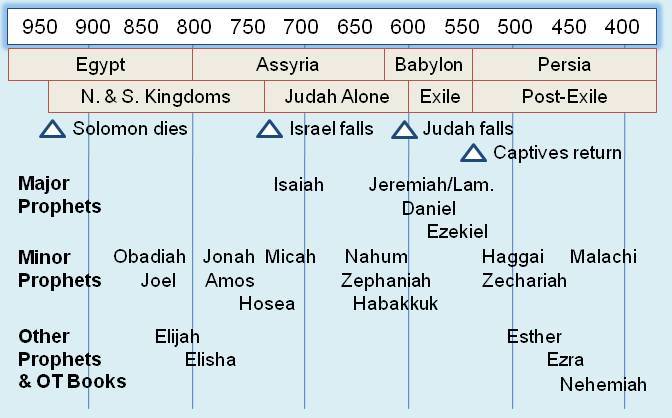
- Hosea, Amos, Jonah, Micah, Isaiah, Nahum, Habakkuk, Zephaniah, Jeremiah
Unknown Date Prophets:
- Joel, Obadiah
Post-Exilic Prophets:
- Ezekiel, Daniel, Ezra, Nehemiah, Haggai, Zechariah, Malachi
Characteristics of Prophecy:
- No dynasty of prophets.
- Primarily poetic and repetitive to express Yahweh’s deep emotions.
- Promise Proclamation (short-term) vs. Future Prediction (long-term)
For Further Reflection: Joel 2 & 2 Samuel 7
THREE COMMON INDICTMENTS
- Idolatry:
- Foreign gods, syncretism, spiritual apostasy
- Injustice:
- Oppression, social corruption, violence
- Abuse of leadership, neglecting the vulnerable, shedding innocent blood
- Immorality:
- Disregard for God’s law
- Self-indulgence, debauchery
- Intermarriage with foreign wives
EXPLORING: THE DAY OF THE LORD
- Originally understood as a day of blessing for Israel and judgment on Israel’s enemies.
- Instead, it became a day of punishment for both Israel and Judah (Amos 5):
- Northern Kingdom – 722 B.C.
- Southern Kingdom – 586 B.C.
Two Aspects of the Day of the Lord:
- Immediate: Acts of God’s judgment and exile (already fulfilled)
- Eschatological: Judgment and restoration (not yet fulfilled)
- Anticipates God’s intervention and engagement in the affairs of mankind.
THE DAY OF THE LORD: MINOR PROPHETS
- Described as “near and hastening” (Obadiah 15; Joel 2:1; Zephaniah 1:14)
- Time clarifies both partial and complete fulfillment.
- Joel warned of a dramatic judgment on Judah through a locust plague (Joel 1:15).
PRE-ASSYRIAN EXILIC PROPHETS
Hosea
- God has yoked Himself to Israel and will not give up on her, even in the face of adulterous unfaithfulness through idolatry (Hosea 1–3).
- God must purify Israel from her infidelity through severe punishment (Hosea 2; 5; 12).
- The call to “return to Me” echoes throughout the story.
- Israel’s unfaithfulness and stubbornness are not enough to exhaust God’s redeeming love (Hosea 3).
Amos
- Israel’s neighbors are denounced one by one (Amos 1:2–2:5).
- Amos then turns the tables on Israel — even greater judgment is coming for you.
- “Woe to you who desire the day of the Lord! It is darkness, and not light.” (Amos 5:18)
- God holds His people more accountable than their neighbors (Amos 2:6–9:10).
- Multiple appeals to “seek the Lord and live” (Amos 5).
- Impending destruction by Assyrian hands awaits, but there is a future hope of restoration (Amos 9).
- Major emphasis on social justice.
Jonah
- Nineveh — capital city of Assyria (Jonah 4:10–11).
- Pagan Gentile outsiders experience God’s grace and compassion (Jonah 4:2).
Micah
- Rulers and prophets of Israel denounced for injustice — likened to cannibalism: “Eating the flesh from my people” (Micah 3:1–3).
- Predicts future Davidic Shepherd Ruler:
- “But you, O Bethlehem Ephrathah, who are too little to be among the clans of Judah, from you shall come forth for me one who is to be ruler in Israel, whose coming forth is from of old, from ancient of days… and he shall stand and shepherd his flock in the strength of the Lord.” (Micah 5:2–4)
- Called to “do justice, to love kindness, and to walk humbly with your God” (Micah 6:8).
- Highlights God’s undeserved love and forgiveness (Micah 7:18–20).
Isaiah
- “God is Salvation”
- Chapters 1–39: Focus on sin and judgment.
- Chapters 40–66: Focus on salvation and deliverance.
- The Angel of the Lord defeats Sennacherib (Isaiah 36–37).
Three Distinct Portraits of the Messiah:
- King (Chs. 1–37)
- Suffering Servant (Chs. 38–55)
- Anointed Conqueror (Chs. 56–66)
Purpose:
- To declare that God will glorify Himself by purifying His people through judgment, with an overarching vision of hope through the coming Messiah.
- The Promised Conquering King will reign on David’s throne forever (Isaiah 9:6–7).
- The ‘Servant Songs’ look forward to the suffering and glory of Jesus.
- The Lord’s Chosen Servant comes in righteousness as a blessing to the nations and a light to the world (Isaiah 42).
- “I will make you as a light for the nations, that my salvation may reach to the end of the earth.” (Isaiah 49:6)
Pre-Babylonian Exilic Prophets
Nahum
- Time Period: 650-630 B.C.
- Key Message: Bridges the gap between Assyrian and Babylonian dominance, announcing and describing the downfall of the Assyrian Empire.
- Key Verses:
- “Thus says the Lord, ‘Though they are at full strength and many, they will be cut down and pass away…and now I will break his yoke from off you and will burst your bonds apart.’” (Nahum 1:12-13)
- “The Lord is slow to anger and great in power, and the Lord will by no means clear the guilty.” (Nahum 1:3)
- Theme: Judgment on wickedness is inevitable.
- Key Verses:
Habakkuk
- Key Message: A dialogue between Habakkuk and God, where Habakkuk is troubled by the moral decay of Judah and God’s silence in response to his prayers.
- Judah’s Blindness: False prophets declare that God will not punish His people.
- God’s Response: He will use the Babylonians to punish Judah (Habakkuk 1:12-2:1).
- Learning to Trust: Habakkuk learns to trust in God, despite troubling circumstances (Habakkuk 3:16-18).
Zephaniah
- Judgment on Judah and the Nations: (Zephaniah 1:2-2:3)
- Key Message: God’s judgment will fall on Judah for idolatry and corruption, and surrounding nations like Philistia, Moab, and Ammon will also face God’s wrath.
- Universal Judgment: No nation is exempt from God’s righteous anger.
- The Day of the Lord: (Zephaniah 1:14-18)
- Describes a terrifying time of judgment marked by God’s wrath and devastation.
- Call to Repentance: (Zephaniah 2:1-3)
- A call for the people to seek God, humble themselves, and repent to be spared from the coming disaster.
- Restoration and Hope for the Remnant: (Zephaniah 3:9-20)
- Key Promise: A faithful remnant will be preserved, purified, and restored to the land. Future peace and the removal of shame will come.
Key Verses:
- “The great day of the Lord is near, near and coming quickly; the cry on the day of the Lord will be bitter, the shouting of the warrior there. That day will be a day of wrath, a day of distress and anguish, a day of trouble and ruin, a day of darkness and gloom, a day of clouds and blackness.” (Zephaniah 1:14-16)
- “Seek the Lord, all you humble of the land, you who do what he commands. Seek righteousness, seek humility; perhaps you will be sheltered on the day of the Lord’s anger.” (Zephaniah 2:3)
- “The Lord your God is with you, the Mighty Warrior who saves. He will take great delight in you; in his love he will no longer rebuke you, but will rejoice over you with singing.” (Zephaniah 3:17)
Jeremiah
- Date of Writing: Between 630 and 580 B.C.
- Purpose: The book records final prophecies to Judah, warning of impending destruction unless repentance occurs. It offers both judgment and hope, promising eventual restoration.
Key Verses:
- “Before I formed you in the womb I knew you, before you were born I set you apart; I appointed you as a prophet to the nations.” (Jeremiah 1:5)
- “The heart is deceitful above all things and beyond cure. Who can understand it?” (Jeremiah 17:9)
- “This is what the LORD says: ‘When seventy years are completed for Babylon, I will come to you and fulfill my gracious promise to bring you back to this place. For I know the plans I have for you,’ declares the LORD, ‘plans to prosper you and not to harm you, plans to give you hope and a future.’” (Jeremiah 29:10-11)
- “On the tenth day of the fifth month, in the nineteenth year of Nebuchadnezzar king of Babylon, Nebuzaradan commander of the imperial guard, who served the king of Babylon, came to Jerusalem. He set fire to the temple of the LORD, the royal palace and all the houses of Jerusalem. Every important building he burned down.” (Jeremiah 52:12-13)
Summary: Jeremiah warns of Judah’s idolatry and immorality, leading to inevitable destruction by the Babylonians. Despite the judgment, God promises future restoration. The nation’s sin would result in exile, but hope remains for their return after seventy years (Jeremiah 29:10).
Foreshadowings:
- “The days are coming,” declares the LORD, “when I will raise up for David a righteous Branch, a King who will reign wisely and do what is just and right in the land.” (Jeremiah 23:5-6) – This points to the coming Messiah, Jesus Christ.
Emerging Themes
- God’s Character: Reveals God’s justice, mercy, and sovereignty in His dealings with His people.
- Discipline and Repentance: Discipline serves to purify and call God’s people to repentance, preparing a remnant for future restoration.
- Holiness and Social Ethics: The prophets call for a higher standard of holiness, justice, and righteousness in both personal lives and communities.
- Hope and Restoration: Despite judgment, the prophets offer a message of hope, promising the eventual restoration of God’s people and the establishment of His Kingdom.
- The Coming Messiah: The prophecies point to the arrival of a Messiah, a King and Servant, who will bring ultimate deliverance, justice, and peace.
 VoxNotas
Leave a comment